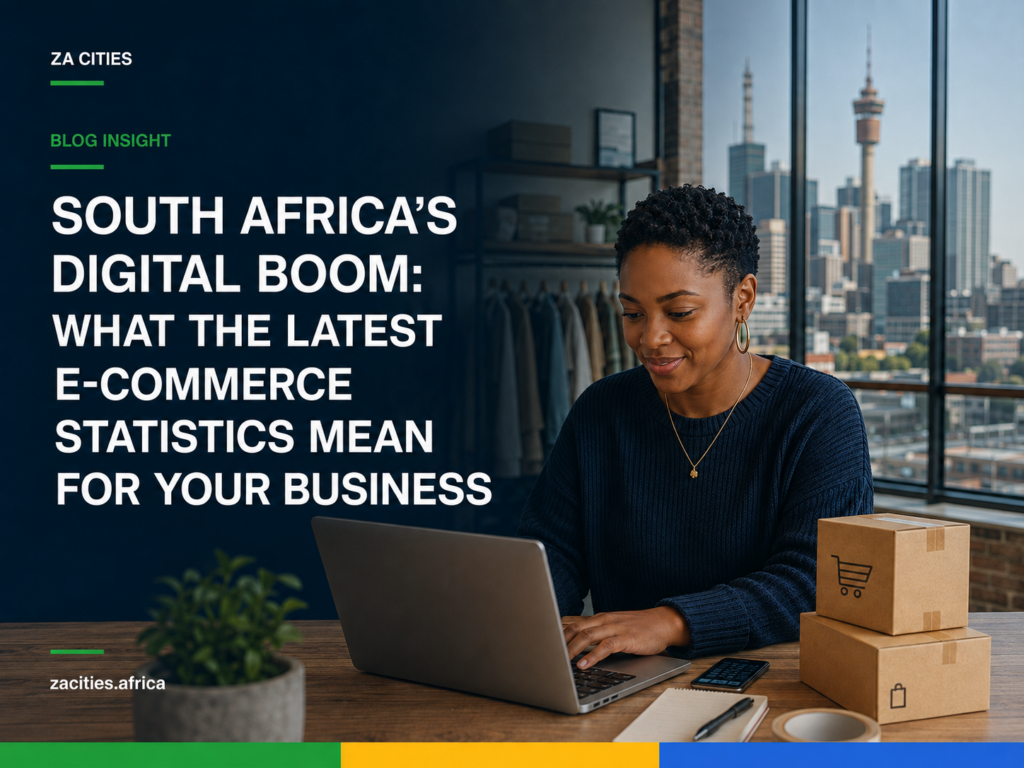
South Africa’s e-commerce market is no longer an emerging opportunity reserved for major retailers. It is becoming central to how consumers discover businesses, compare products, evaluate services and make purchasing decisions.
According to the Online Retail in South Africa 2025 study, online retail grew by approximately 35% in 2024, reaching R96 billion and accounting for 8% of total retail sales. The market was projected to exceed R130 billion in 2025, bringing e-commerce close to 10% of South Africa’s retail activity.
These figures reveal more than an increase in online shopping. They signal a fundamental change in consumer behaviour. Even when a transaction is completed in person, the customer’s decision will often begin online.
The question is no longer whether customers are moving online. It is whether South African businesses are digitally prepared to be discovered, trusted and chosen.
The Customer Journey Has Become Digital
A customer can now discover a product through social media, search for the business on Google, compare options, read reviews, communicate through WhatsApp and complete a secure payment without entering a physical store.
Statistics South Africa reported that income generated through e-commerce sales increased from R37.4 billion in 2018 to R86.8 billion in 2022. Over the same period, e-commerce’s contribution to total sales grew from 3.9% to 7.7%.
This shift affects far more than traditional online retailers. Restaurants, contractors, law firms, salons, tourism businesses, guesthouses and independent professionals all participate in digital commerce when customers find and evaluate them online.
A company may provide an exceptional service, but that advantage is weakened when a potential customer finds an outdated website, inconsistent contact details or no professional online presence. Digital friction creates uncertainty, while a clear and credible experience gives customers confidence to take the next step.
Mobile-First Is Now a Business Requirement
Many South African customers will encounter a business for the first time on a smartphone through Google Search, social media, Google Maps, an advertisement or a link shared on WhatsApp.
A mobile-first website must make important information immediately accessible. Customers should be able to understand the offer, confirm the service area and contact the business without navigating complicated menus.
Website performance is equally important. Large images, unnecessary animations and excessive scripts can slow a website down and consume more mobile data. Businesses should monitor page speed, responsiveness, visual stability and Google’s Core Web Vitals.
The purpose of technology is not simply to make a website look impressive. It is to remove friction between customer interest and customer action.
Having a Website Is Not Enough
Launching a website does not automatically make a business visible on Google. Search engines need clear signals to understand what the business offers, where it operates and which searches its pages should appear for.
A strong search engine optimisation foundation should include:
- Clear page titles, headings and meta descriptions
- Original product, service and location-specific content
- Accurate Google Business Profile information
- Secure HTTPS hosting and strong mobile performance
- Descriptive image names, alternative text and structured data
For example, a generic page called “Our Services” provides limited context. A focused page about “Commercial Cleaning Services in Johannesburg” gives customers and search engines a clearer understanding of the offer.
Businesses serving multiple cities can create dedicated pages for each market, but the content must be genuinely useful and locally relevant. Copying the same page and changing only the city name provides little value.
Trust Has Become a Digital Business Asset
E-commerce growth has created opportunity, but it has also made consumers more cautious. Before sharing information or making a payment, customers look for evidence that a business is legitimate.
A professional website, secure connection, recognisable payment provider, clear policies, authentic reviews and consistent company information all contribute to digital trust.
A relevant domain and branded email address also create a stronger foundation. Communication from an address such as sales@yourbusiness.joburg can feel more established than correspondence from a generic personal account, particularly when sending quotations, invoices or payment instructions.
A domain cannot create trust on its own. It must be supported by dependable service, accurate information and secure systems. However, it gives the business a consistent digital identity on which that trust can be built.
Local Search Creates a Major Opportunity
A significant amount of online behaviour is location-driven. People search for accountants in Johannesburg, accommodation in Cape Town, Durban event venues and services “near me” because location affects convenience, availability and delivery.
These searches often carry strong commercial intent. The user may be preparing to call, book, visit or purchase.
Businesses can strengthen local visibility through an accurate Google Business Profile, consistent contact information, locally relevant content, customer reviews and a clear city-based identity.
A geographic domain such as yourbusiness.capetown, yourbusiness.joburg or yourbusiness.durban communicates local relevance before the customer even visits the website.
A city domain should not be treated as a guaranteed shortcut to higher search rankings. Its value lies in making the business’s location clearer, improving memorability, differentiating the brand and strengthening locally focused campaigns. When combined with sound technical SEO and useful content, that identity can become a meaningful digital advantage.
Where ZA Cities Fits into South Africa’s Digital Growth
ZA Cities is helping to digitise South African cities through the .capetown, .joburg and .durban domain extensions. These geographic domains give businesses, organisations and city-based initiatives locally relevant digital identities connected to the places they represent.
A .capetown domain can reinforce tourism, hospitality, creative and lifestyle brands connected to Cape Town. A .joburg domain can support Johannesburg service providers, professionals, events and community platforms. A .durban domain can strengthen the identity of retailers, tourism operators, cultural initiatives and professional services in Durban.
These domains are not only for new companies. Established organisations can use them when entering a new city, launching a location-specific service or creating a dedicated metropolitan campaign.
The Opportunity Belongs to Digitally Prepared Businesses
South Africa’s e-commerce boom allows smaller businesses to reach wider markets and helps consumers discover companies they may never encounter through traditional advertising. But increased opportunity also creates increased competition.
Businesses do not all need advanced online stores or mobile applications. They do need a reliable digital foundation: a memorable domain, a mobile-friendly website, useful search-optimised content, secure technology and clear ways for customers to take action.
ZA Cities supports this transition by enabling businesses to establish distinctive local identities through .capetown, .joburg and .durban.
South Africans are already searching, comparing, booking and purchasing online.
The real question is: will your business be visible when they search for what you offer?
Sources
- Mastercard: South Africa’s Online Retail Set to Surpass R130 Billion in 2025 — mastercard.com
- Statistics South Africa: The Rise of E-commerce in South Africa — statssa.gov.za
- ZA Cities — zacities.africa