Not long ago, starting a local business meant hitting a digital wall early on. You had the product, the passion, and a neighbourhood waiting for your services, but getting online was a drawn-out, expensive hurdle. You needed a web developer, a graphic designer, and a decent budget just to launch a simple storefront.
That barrier has officially broken .
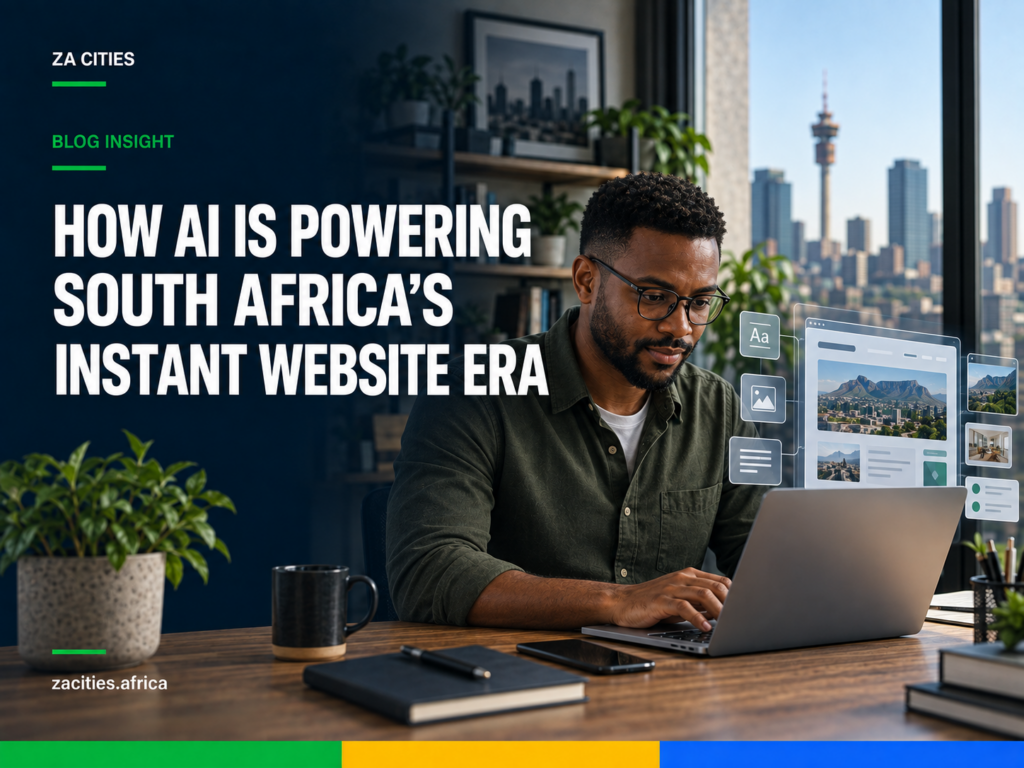
We have entered the era of visual, No-Code platforms paired with Artificial Intelligence (AI), a shift that lets virtually anyone go from an idea to a live, polished website in an afternoon without writing a line of code. But launching a site quickly is only half the battle; people still need to find you, relate to you, and trust you enough to spend their money.
That is where South Africa’s city-specific domain extensions like .joburg, .capetown, and .durban come in. When you take effortless, AI-driven website creation and anchor it to an unmistakable local identity, digital commerce for small businesses changes completely.
Understanding the “No-Code” Shift
“No-Code” simply refers to modern design tools that replace programming with visual editors, drag-and-drop elements, and smart templates.
Where business owners used to hire developers to code layout structures, platforms like Wix, and Shopify made visual site-building mainstream. AI builders have now taken that concept a giant leap further:
- Instant Layouts from Simple Prompts: Instead of starting with a blank canvas, you can give an AI tool a basic instruction such as “I run a boutique coffee roastery in Maboneng” and watch it build a styled site complete with suggested page structures, custom graphics placeholders, and starter text.
- Smart Content Creation: Writing website copy is often a huge bottleneck for owners. Integrated AI assistants help draft clear service descriptions, team bios, and customer FAQs in minutes, giving you a strong baseline to refine.
- Plug-and-Play Operations: Adding online payment gateways (like Yoco or PayFast), booking systems, or automated WhatsApp links used to require complex backend integration. Now, they click into place with standard settings.
Technology that once required tens of thousands of Rands and weeks of back-and-forth can now be launched over a weekend.
Why Local Grounding Matters: The Case for City Domains
Having an instant website is fantastic, but your web address (your domain) dictates how potential customers judge your business at a glance.
For decades, South African businesses default to .co.za. While standard domain extensions remain valuable, city extensions; .joburg, .capetown, and .durban give local businesses a distinct advantage:
- Immediate Community Trust: When a shopper sees .joburg or .capetown in a web link, they immediately know you are right there in their city. It signals faster delivery times, local customer service, and real accountability.
- Unclaimed Digital Real Estate: Finding a short, clean domain name on legacy extensions is notoriously difficult because most obvious words are taken. City domains offer a fresh landscape where you can secure your exact business name without awkward hyphens, typos, or filler words.
- Local Search Relevance: Search engines prioritize showing users results that match their geographical context. If someone in Kwazulu-Natal searches for “artisan plumbing services,” a clear local signal like .durban helps establish relevant geographic context right away.
Lowering the Barrier for Local Entrepreneurs
This shift isn’t just about faster tech; it is about economic access. Small business owners, freelancers, and community initiatives no longer have to wait on massive budgets to look established online.
- Step 1: Secure Your Local Name
Claim your brand under your city extension (e.g., yourbrand.joburg or yourbrand.capetown) through an accredited registrar.
- Step 2: Generate the Layout with AI
Use a modern AI website builder. Input your business niche, primary services, and city location to generate a functional, mobile-friendly starting template.
- Step 3: Personalize with Authentic Details
Swap in high-resolution photos of your actual work, adjust the colours to match your branding, and tweak the written content to reflect your voice.
- Step 4: Connect Payments and Publish
Link your preferred South African merchant account, hook up your city domain, and launch your store to the public.
A Digital Identity Rooted in Home
The combination of No-Code flexibility and city-level digital identities is reshaping how local commerce operates. A neighbourhood bakery in Cape Town, an electrician in Johannesburg, or a local design studio in Durban can now build a digital presence that looks every bit as sharp and reliable as a national brand.
By eliminating technical bottlenecks, AI tools give local entrepreneurs the speed to start quickly. By pairing those sites with .joburg, .capetown, or .durban domains, businesses don’t just put up a web page, they build a digital home firmly rooted in the city they serve.